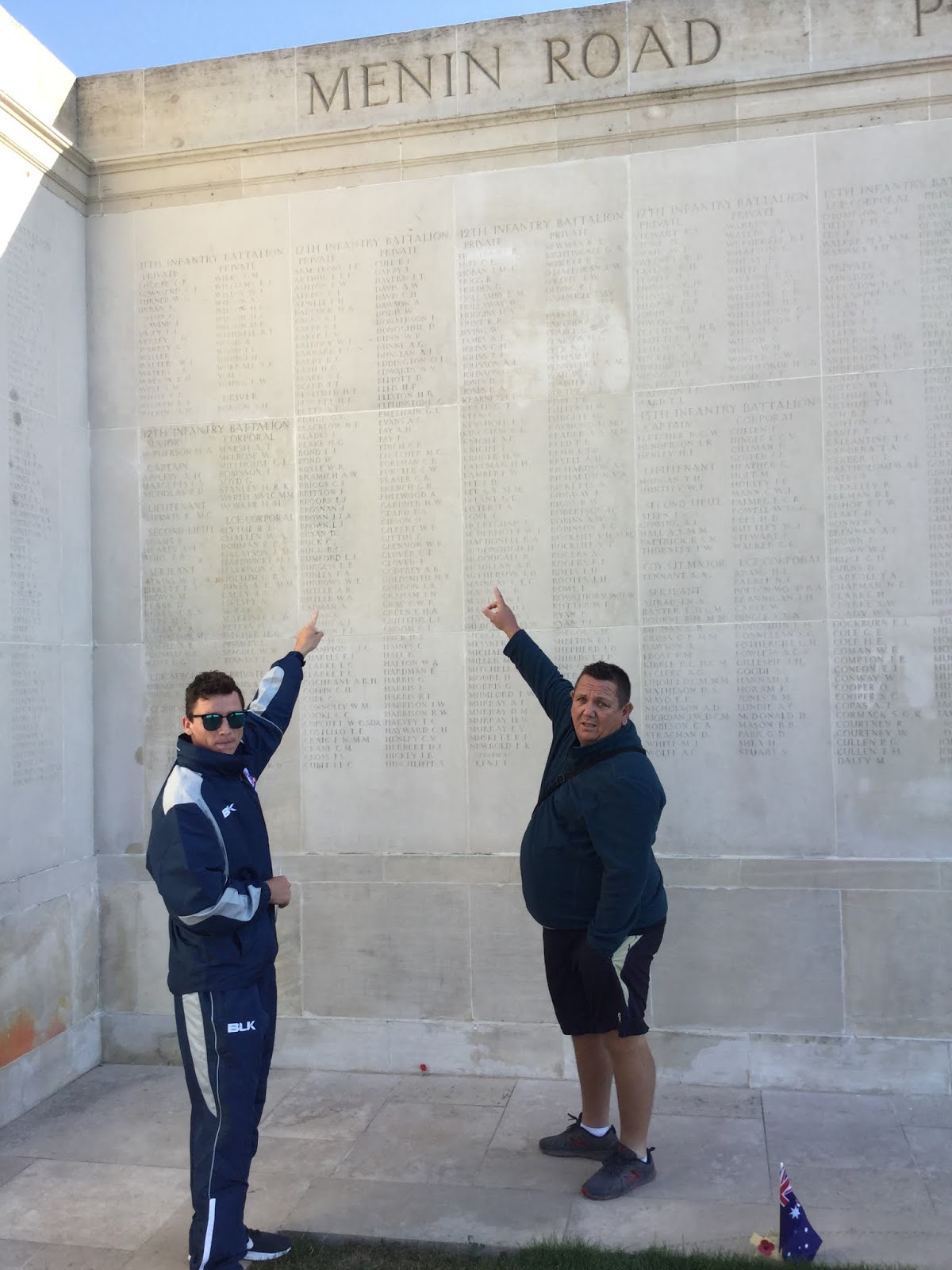
Thursday, 26 September 2019

Day 4 - BATTLEFIELD TOUR AND OFF TO ENGLAND

On our fourth day we met our second tour guide Filip, a local secondary school History teacher. Not only did he have a great sense of humour, his knowledge of the places we visited was outstanding. He entertained the boys with some great stories and there wasn't a question he could not answer.

We started our tour at Hill 60; an area of ground which remains relatively undisturbed since the end of the Great War. During the Great War there was fierce fighting here, and the hill changed hands between the Germans and the Allies several times. Both sides also dug tunnels and planted mines underneath the hill. Because of this, the remains of many soldiers from both the Allied and German forces still lie here.

The next stop was Langemark cemetary. Unlike the previous cemetaries we had visited, Langemark was a German cemetary. The contrast of the German memorial to the Commonwealth ones that we had visited in the past days was chalk and cheese. Massive Oak trees surrounding the memorial blocked out any sun trying to get in. Where the Commonwealth headstones were white the German ones were dark and moody. The most outstanding feature, however, was that unlike Commonwealth plots where every soldier was given an individual burial and headstone, the German soldiers were buried 5-6 to a plot. In one area 25000 Germans had been buried together as comrades in the same grave.

The contrast was even more prominent when we visited our next stop; Tyne Cot cemetery. Tyne Cot is the largest Commonwealth War Graves Commission cemetery in the world. It is now the resting place of more than 11,900 servicemen of the British Empire from the First World War. There were two Townsville soldiers that we located and Tour Captain Zac Thomson led the group in reciting the 'Ode of Remembrance' over their final resting places.
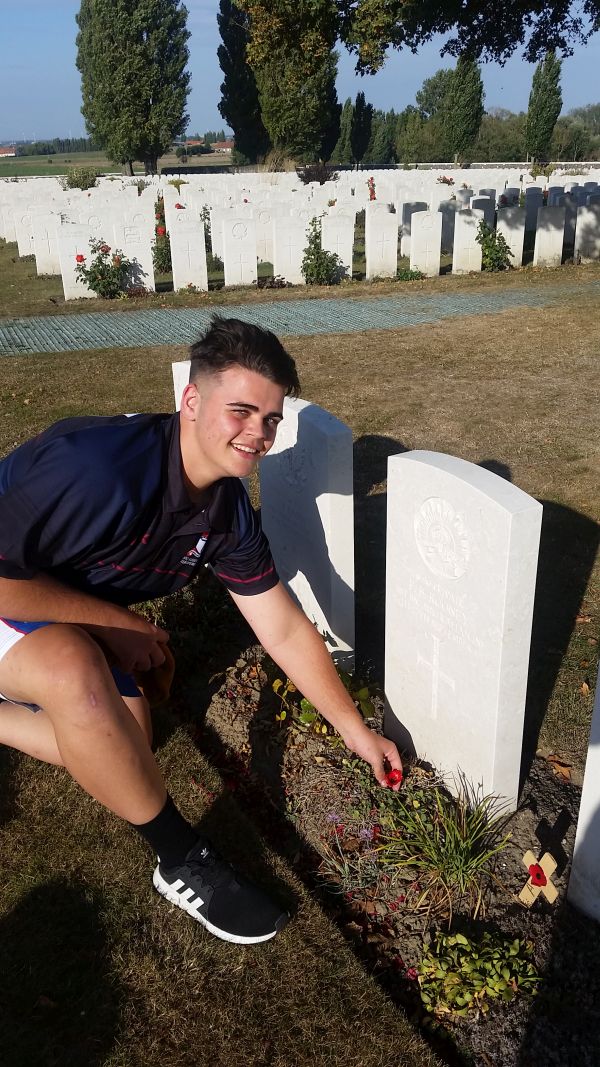
Terrence Rooney laying a poppy at the Headstone of  Private P.B Rooney
31st BTN Australian Infantry

Our final stop in Belguim was Polygon Wood; a large wood which was completely devastated in the First World War. The wood was cleared by Commonwealth troops at the end of October 1914, given up on 3 May 1915, taken again at the end of September 1917 by Australian troops. Polygon Wood was a picturesque cemetery surrounded by beautiful countryside and manned by a lone Donkey called Tomanky.

The boys presented Fillip with a IPC Rugby tie to thank him for his time and wealth of knowledge and we got back on the bus and made our way to the ferry to take us across the English Channel to the 'Motherland'.

Day 3 - COBBERS MEMORIAL AND YPRES

After saying goodbye to our guide it was a quick visit to Cobbers Memorial; a large bronze statue featuring a soldier from Western Victoria carrying a fallen comrade from the field and is a memorial to Australian service and sacrifice at the Battle of Fromelles during World War One.

We then drove into Belgium and visited the town of Ypres; best known as the site of three major battles of the First World War, the most famous being the Battle of Passchendaele from July—November 1917. Attending the Last Post ceremony that night at the Menin Gate was a special treat as the boys laid a wreath to commemorate the fallen soldiers. That night there was also a choir which added to the reverent atmosphere.
It had been a big day and we all slept well that night.

Day 3 - VILLERS BRETONNEUX

After Pozieres it was of to Villers Bretonneux, a 30 minute drive through the beautiful French countryside. The Australians and French had secured Villers Bretonneux after days of intense fighting in which 1200 Australians lost their lives. They were able to establish a new front line, marking the end of the German offensive on the Somme. A parricular poignant experience was visitng "Victoria School" which was built from the donations of Victorian school students in Australia on the same site of the one destroyed in 1918.

In the courtyard of the school, in addition to an Australian fresco in the Aboriginal style made by the children of the school and inaugurated at Anzac day 2009, is written on the courtyard in green letters on a yellow background the following message :


"DO NOT FORGET AUSTRALIA"

This message, translated as "never forget Australia" expresses the wish of the duty of memory and recognition. It is at the origin of the close ties between the people of Australia and the inhabitants of Villers-Bretonneux.

This inscription is in French in each classroom in the school.


While at Villers-Bretonneux we also had an opportunity to visit the Sir John Monash Centre which is set on the grounds of the Villers-Bretonneux Military Cemetery in northern France. The boys got to experience the Australian Western Front through a series of interactive multimedia experiences. While at the cemetary the boys placed poppies on a number of soldiers headstones as well as locating a couple of Townsville born soldiers.

This was the last stop for our tour guide Perrine. The boys presented her with an Australian scarf to thank her for providing the group with her knowledge of the surrounding countryside and the events that occured there during World War I.

DAY 3 - POZIERES - THE AUSTRALIAN WAR MEMORIAL AND THE WINDMILL

The next stop was to two important sites related to the Battle of Pozieres.

The first site was the Pozieres Memorial. The high ground at Pozières was an essential advantage, and a place from which further attacks could be launched. The 1st Division was the first to go into the battle, and did so on 23 July 1916. The Australians managed to capture the village of Pozières, whereupon they were subjected to relentless artillery bombardment that reduced the village to rubble and inflicted a heavy toll among the allied troops. The 2nd Division relieved the 1st, and suffered even more losses attacking towards the heights east of the village. The 4th Division then went in, pressing its attack north towards Mouquet Farm and holding off German attempts to retake Pozières. Each of the three Australian divisions, though severely reduced, served a second tour on this notorious battleground.
The memorial commemorates the officers, non-commissioned officers and men of the First Australian Division who fought in France and Belgium in 1916, 1917 and 1918. The boys payed their respects by placing poppies beside the names of a number of fallen Australians.

The highest ground in the area of Pozieres was the site of a windmill. From this spot you could see advancing troops in all directions. The windmill was secured by Australian forces on August 5 1916.
Australia's official war historian, Charles Bean, said, 'The Windmill site … marks a ridge more densely sown with Australian sacrifice than any other place on earth'. 
The windmill was gradually smashed up by artillery fire. It was eventually reduced to a pile of rubble. Remains of the windmill and the German blockhouse have been left and grassed over, leaving the undulating ground as a preserved battlefield site at this place.

Day 3 - LOCHNAGAR MINE CRATER

After the arrival of our first tour guide, Perrine, we visited the Lochnagar mine crater on the Somme battlefield in France. The crater which is 30m deep and 100m wide is the largest man-made mine crater created in the First World War on the Western Front. From their own trenches the allies tunneled across no man's land to the German lines and blew them up - this only partially worked as the German's had already retreated to fall-back trenches - 200 killed.
The crater has been preserved as a memorial and a religious service is held each 1 July.

Sunday, 22 September 2019

DAY 2 - PARIS PHOTO TOUR & OFF TO BED

Having arrived at approximately 2.30 pm at the Charles de Gaul Airport in Paris we embarked on a whirlwind, short, photo tour or a couple of the main Paris landmarks. On a gorgeous sunny day we made our way to the Eiffel Tower for a photo opportunity. Battling peak hour traffic our bus driver, Joe, got us there and off we went to stretch our legs.


With the Eiffel Tower done we were off to the manic round about at the Arc de Triomphe - if on the round about you are not insured - quite the experience - go hard Joe. Getting off here the boys snapped a couple of happy snaps and then it was back on the bus to the Somme - Albert, the place of another courageous victory for Australian troops.


DAY 1 BON VOYAGE

THURSDAY 19 SEPTEMBER


The Townsville airport was buzzing on Thursday as it was not only IPC Rugby Union travelling it was IPC Rugby , IPC Football, The Cathedral School Rugby and The Cathedral School Netball. Fours teams checking in for the trip of a life time.

With everyone very excited about the trip ahead it wasn't long before we were all on our way to Brisbane to Abu Dhabi (14 hours) and onto Paris (8 hours). Having crossed the date line we arrived in Paris on Friday 20 September at 2.30pm.